
OEM/ODM Jewelry Manufacturing in Six Documented Steps
A custom jewelry order runs through six named stages: inquiry, consultation and development, CAD and prototype, sample and approval, bulk production, then final quality control and delivery. Only three of them carry a published duration — CAD back within CAD 25–30 days to a master sample, a further 3–4 weeks to bulk, 48 hours to CAD — CAD, sample, run (run) (run) — and the sampling block alone divides into five workshop operations at roughly five to six days each.

Key takeaways
- Six stages carry the order from first message to shipped carton, and each one ends with something you can check.
- CAD and prototype is the shortest stage at under 48 hours; sampling is the longest at 25–30 days.
- Sampling covers five operations — wax printing, mould casting, stone setting, polishing and electroplating.
- Final QC inspects 100% of pieces before packing, with ISO 9001:2015 covering how the process is documented.
Steps one and two: inquiry, then consultation and development
Step one is a message. Sketches, reference photographs, a competitor piece with notes, or a tech pack if you have one — all four are accepted, and none of them needs to be tidy. What the workshop wants from that first contact is the material, the finish, the packaging direction and roughly how many pieces you expect in the first run.
Step two is where those four answers turn into a plan: whether the design is feasible at the size you want, which base metal suits it, and how the cost structure breaks down across plating, stones and packing. Nothing has been cut yet, so this is still a cheap stage to change direction in.
Step three: CAD and prototype inside 48 hours
The third stage is screen work. A 3D CAD drawing and a set of realistic renderings come back inside 48 hours for dimensional sign-off, which means you approve the thickness of a band or the drop of a pendant before any tooling exists. Renderings are not decoration — they are the document the later sample is measured against.
Because the stage is fast, it is tempting to wave it through. Do not. A dimension settled here costs nothing to change; the same dimension discovered after casting means a new wax print and a new mould.
Step four: sample and approval across 25–30 days
Stage four is the one that decides the launch date. A master physical sample is built through wax printing, precision mould casting, stone setting, polishing and custom electroplating, and the published window is 25–30 days. Feedback at this point is expected, and a single round of adjustments is normal rather than a failure.
This is also the stage where an ODM jewelry manufacturer earns its keep beyond drawing: the piece is finished exactly as the production run will be finished, which is the only way to judge a plating stack on a real surface.
Step five: bulk production in 3–4 weeks
Once the sample is approved, the tooling is already proven and the run moves to a controlled line: automated tooling for the repeatable operations, artisan finishing for the surface work. The published window is 3–4 weeks, and where a job lands inside that range depends on batch volume and design complexity rather than on the calendar.
| Stage | Published timing | What you supply |
|---|---|---|
| 1. Inquiry | 24-hour response | Sketches, photos or a tech pack |
| 2. Consultation and development | Feasibility and cost structure | Material and finish preferences |
| 3. CAD and prototype | under 48 hours | Approval of the drawing and renderings |
| 4. Sample and approval | 25–30 days | Sample verdict and adjustment notes |
| 5. Bulk production | 3–4 weeks | A firm piece count per design |
| 6. Final QC and delivery | 100% inspected | Packaging artwork and shipping details |
Step six: inspection, packing and delivery
The last stage is the least glamorous and the one that decides whether a retail partner reorders. Every piece is inspected rather than sampled, then packed with whatever branding was chosen — velvet/microfiber pouches, metallic logo tags, backing cards for display, bar-coded labelling and foil-stamped boxes — and shipped with customs support.
Ask for the inspection record with the carton. A line that says 100% inspected is a claim; a signed sheet per batch is a procedure.
Worked example: 30 days spread over five sampling operations
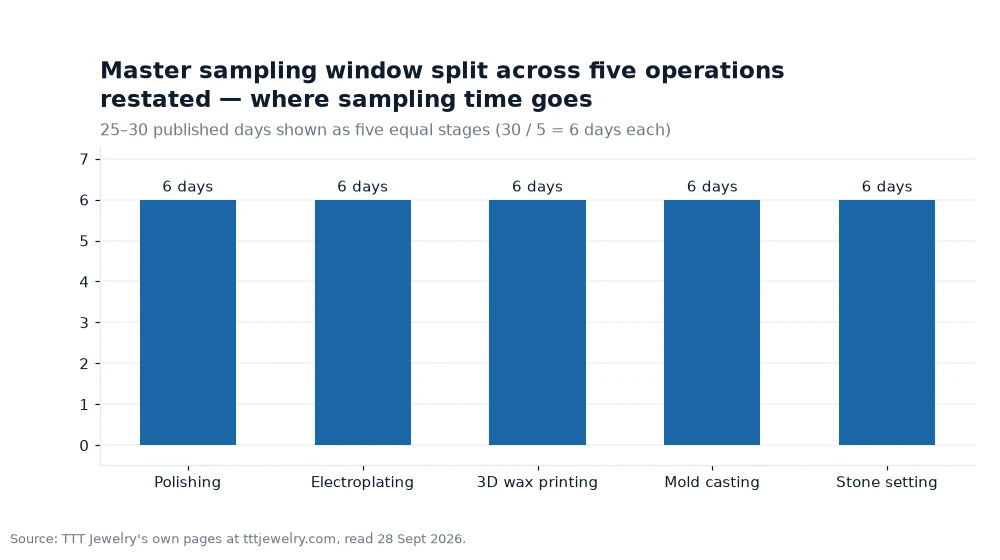
Take the outer edge of the published sampling window, 30 days, and divide it by the five operations named for that stage: 30 ÷ 5 = 6 days per operation for wax printing, casting, stone setting, polishing and electroplating. At the inner edge, 25 ÷ 5 = 5 days each.
So the realistic per-operation allowance is five to six days. Adding a second stone-setting pass does not add a day to the total, it adds five or six, because that station runs again in sequence. Both divisions are my arithmetic; 25–30 days and the five-operation list are published.
What the six stages look like on an invoice
Suppliers who quote a single price are usually hiding the stage that cost them most. Ask for the four decisions that drive cost separately: base metal, plating stack, stones and packaging. The six-stage list is useful precisely because it gives you four natural places to ask what a change would do — and the answers come from the same document every time, which is what makes quotes comparable between suppliers.
Where the boundaries between stages blur
Stages two and three overlap in practice. Consultation decides material and plating, and the CAD file cannot be drawn properly until those are settled, so a buyer who replies slowly on material effectively pauses stage three as well. The published 48 hours is a turnaround on a brief that is complete, not a fixed block of calendar time that runs whether or not anyone answers.
The same applies between stages four and five. The sample window of 25–30 days ends with a physical piece that has to be judged, and production cannot start until that judgement arrives. A buyer who takes ten days over a sample review adds ten days to the shipment, no matter how quickly the workshop moves. The two stages with published durations are both gated by somebody outside the building.
Frequently asked questions
Do all six stages run on every order?
Yes on a new design. On a repeat order the sampling stage drops out because the mould and the finish already exist, which is why reorders move straight to production.
Which stage can I skip to save time?
None of the six, but you can shorten your own side. Approving the CAD file and the sample quickly is the only part of the calendar a buyer controls.
Is the sample stage different for sterling silver and brass?
The five operations are the same; the differences sit in the base material and the finishing. Silver takes an anti-tarnish e-coating over the plating, while eco-brass gets the same protective treatment on a plated base.
Turning the six stages into a checklist you can hold a supplier to
Print the list and ask for a status against each line, in the supplier's own words. A factory that can say where your order sits — drawing approved, sample in setting, production started — is one that has documented the process rather than improvised it.
Material choice changes what the sample looks like at stage four, so it is worth reading how the 925 sterling silver route is finished before you brief, and how the stainless steel line handles wear and water with PVD vacuum plating.
What this article works from — the approved-sample benchmark, followed by the 100% NDA terms — is written up at the manufacturer's own website on the tttjewelry.com site, read 28 Sept 2026. Nothing else here is inferred. The day-and-week bookkeeping is my own working, and nothing else here[1].